Dating guide
How to know if you are compatible with someone
Here's how to know if you are compatible: you agree on the things that are hard to change (values, kids, the kind of life you want), your everyday routines fit without one of you constantly giving in, you can talk about difficult things, you repair after a fight, your needs for intimacy sit in a similar range, and you're walking toward a similar future.
Compatibility doesn't mean being the same. It means your differences are ones you can both live with. This guide breaks it into six areas, with concrete questions for each, a simple way to score what you find, and the signs that tell you it's working, or that it isn't.
What being compatible really means
People often confuse compatibility with similarity. You don't need the same hobbies, the same playlist or the same opinions about pineapple on pizza. What you need is agreement on the things that shape a shared life, and a good way of handling everything else.
A helpful distinction:
- Core fit: values, kids, exclusivity, money habits, where and how you want to live. Differences here tend to grow over time.
- Style fit: how social you are, how tidy, how you spend weekends. Differences here create friction, but they're negotiable.
- Relational skills: how you communicate, handle conflict and show care. These can be learned, but only if both people want to.
Why chemistry can fool you
Strong attraction makes everything feel compatible for a while. The rush smooths over differences you'd notice immediately in a friend. That's not a reason to distrust chemistry, just a reason to look at compatibility on purpose. If you're unsure which one you're feeling, read our guide to chemistry vs compatibility.
The six areas of compatibility
Look at each one separately. Two people can be a perfect fit in three areas and struggle in a fourth.
Values
What you consider right, important and non-negotiable: honesty, family, faith, fairness, ambition. The deepest layer and the hardest to change.
Lifestyle
What an ordinary week looks like: routines, social life, health, money habits, pets, where you live. The layer you feel every single day.
Communication
How you share, listen and ask. Whether you say what you need or expect the other person to guess. Whether you feel understood.
Conflict
Not whether you fight, but how. Do arguments end with understanding or with a winner? Can you apologize and repair?
Intimacy
Affection, desire, pace and boundaries. How close you like to be, and how comfortable you are talking about it.
Future
Kids, commitment, career, where you want to be in five or ten years. The direction you're both walking in.
1. Values: do you agree on what matters?
Values show up less in what people say and more in what they do when it costs them something. Watch how someone talks about their family, how they treat a waiter, what they do when nobody's watching. Explore this deeper in shared values compatibility.
Questions to ask or observe:
- What's something you'd never compromise on, even for someone you love?
- How important is religion or spirituality in your daily life?
- When have you stood up for something at a personal cost?
- What does loyalty mean to you, with friends and with a partner?
- What do you admire most in the people close to you?
2. Lifestyle: do your weeks fit together?
Lifestyle compatibility is about rhythm. An early riser who loves quiet Sundays and a night owl who needs a plan every weekend can make it work, but it takes effort every week. Look at daily habits and social life honestly, and at money too: it's a lifestyle issue before it's a numbers issue.
Questions to ask or observe:
- What does a perfect ordinary weekday look like for you?
- Do you recharge alone or with people?
- How do you feel about drinking, smoking, working out?
- Are you a saver, a spender or somewhere in between?
- Do you want pets in your home?
3. Communication: do you feel understood?
Good communication isn't talking a lot. It's feeling that what you say lands the way you meant it. Notice whether the other person asks follow-up questions, remembers what you told them and checks in when they're not sure. Notice, too, whether you feel free to say what you need.
Questions to ask or observe:
- How do you like to be told when something's bothering someone?
- Do you prefer to talk things through right away or take time first?
- How do you show someone you care about them?
- What makes you feel really listened to?
- Do they ask about your life, or mostly talk about theirs?
4. Conflict: can you disagree and come back together?
Every couple argues. What predicts whether it works is how. Watch for contempt, sarcasm, stonewalling and scorekeeping; watch for the ability to say “you're right, I'm sorry” and mean it. You don't need a big fight to learn this. Small frictions, like a late arrival or a change of plans, tell you plenty.
Questions to ask or observe:
- How did your last disagreement with a friend end?
- Do you need space after a conflict or to resolve it right away?
- What's hard for you to apologize for?
- When plans change, do they adapt or sulk?
- Do disagreements end with understanding, or with a winner?
5. Intimacy: are your needs in a similar range?
Intimacy is more than desire. It's how much affection you like, how you show it, how fast you like to move and how open you are to talking about it. Mismatches here are common and rarely discussed, which is why they last. You don't need details early on; you need a sense of whether you can talk about it at all. Our guide to talking about desires can help you start.
Questions to ask or observe:
- How important is physical affection in your day to day?
- Do you like public affection, or do you keep it private?
- Do you like to take things slow, or follow the moment?
- How comfortable are you talking about what you like and don't like?
- Does this person respect a no the first time?
6. Future: are you walking in the same direction?
You don't need a five-year plan on the second date. But you do need to know whether your futures point the same way. The classic mismatch is children (see family and kids compatibility), followed by where to live and how much room career takes up.
Questions to ask or observe:
- Do you see children in your future?
- Where do you imagine living in five years?
- What would you like to have changed in your life by then?
- What does commitment look like to you?
- Are you looking for something serious, casual, or still figuring it out?
How to know if you are compatible: a simple scoring method
After a few dates, take ten minutes and do this on paper. It's surprisingly clarifying.
- 01
Start with yourself
Before judging fit, write down your own answers for each area. You can't tell whether someone matches a picture you haven't drawn. Your deal breakers go at the top.
- 02
Color each area
Green: we agree, or our differences feel easy. Yellow: we differ, but it seems workable. Red: we clash on something that matters to me. Be honest; nobody else will see it.
- 03
Weigh what you found
A red on values or future counts far more than a red on social life. Several yellows are normal. One red in a core area deserves a real conversation.
- 04
Check behavior, not just words
Anyone can say the right thing. Over the next dates, see whether actions match answers. Consistency over time is the best compatibility test there is.
Signs you're compatible, and signs you might not be
Put the six areas together and some patterns tend to appear.
Signs you're compatible:
- You can be yourself without editing
- Plans are easy to make because you want similar things
- Disagreements end with more understanding, not less
- You feel calmer after seeing them, not more anxious
- Your friends notice you seem like yourself around them
- Talking about the future feels exciting, not tense
- Differences feel interesting rather than threatening
Signs you might not be compatible
You avoid certain topics because you already sense the answer. You keep shrinking your needs to keep the peace. Every plan becomes a negotiation. You're waiting for them to change on something important. The chemistry is strong but you feel lonely inside it. None of these means someone is a bad person; they mean you might want different lives, and that's worth knowing early.
Can a compatibility test really help?
A good test won't tell you who to love. What it can do is ask the questions people avoid on first dates and show where you line up before feelings make it harder to see. Use a compatibility test as a conversation starter, not a verdict. The most useful ones compare you area by area instead of giving one mysterious number, so you can see where you fit and where you'd have to talk.
How Naughty Singles measures compatibility
Naughty Singles turns this whole framework into a game. You play cards with first-person statements (“I plan my whole week on Sunday afternoon”) and answer ME TOO, DON'T CARE or NOT ME. Each card measures one category, and your answers build your Match DNA: an affinity profile across 40 compatibility categories, ten for each intensity level. LIGHT, your day to day, is always on; flirting, desire and more intense levels are opt-in.
The comparison is transparent. Categories match, not phrases, so two people don't need to have seen the same cards. You're only compared on the levels you both chose. More intimate levels weigh more, and the worst level weighs: if you're identical in daily life but opposite in desire, the total drops instead of averaging out. Your deal breakers work as a gate on your top (and theirs on theirs), and everything is calculated in both directions.
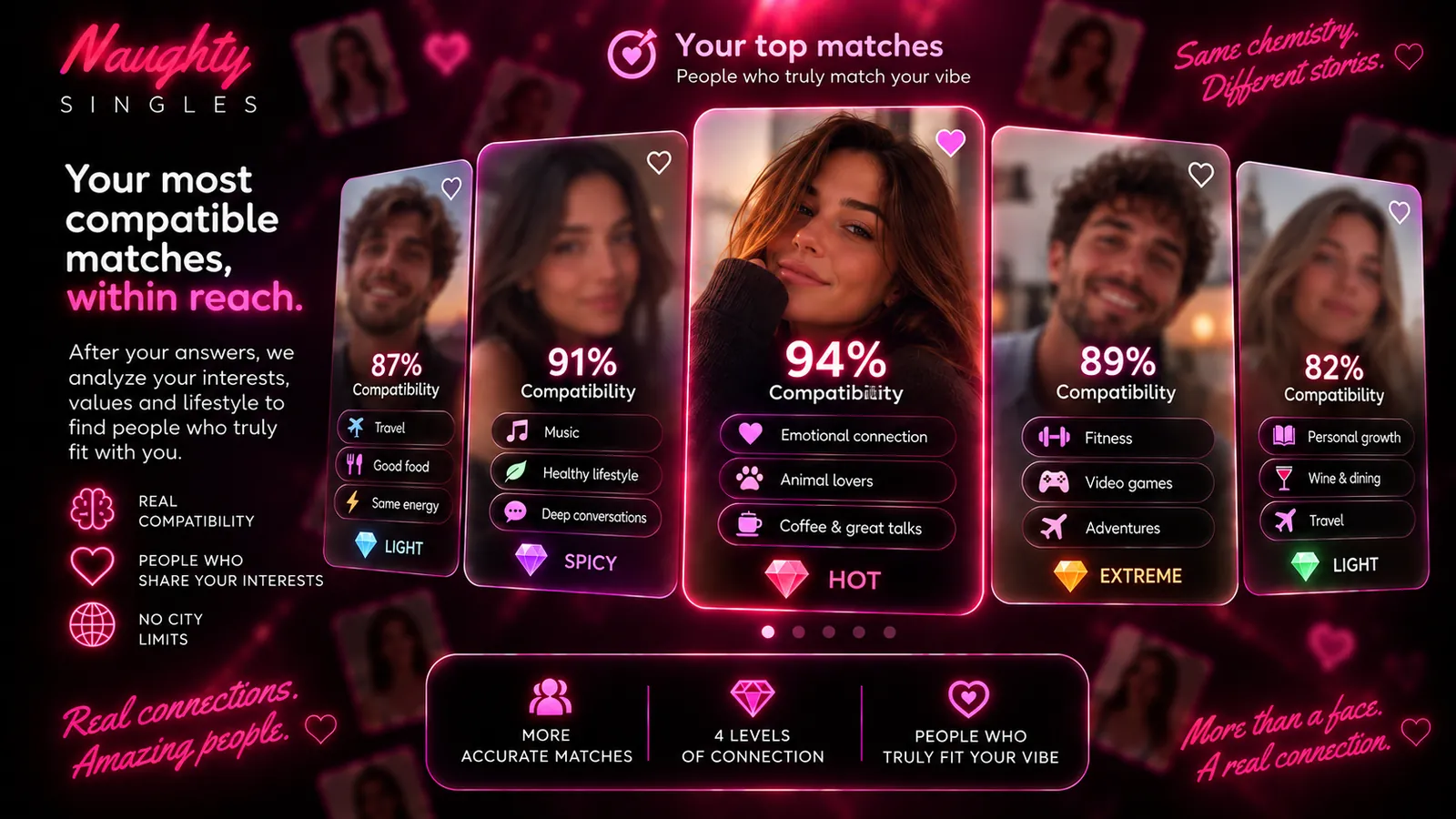
The result is a top of real people with a compatibility percentage, a reading per level and why you'd connect, with faces blurred until there's real interest. The app launches in English, Spanish and Portuguese at the same time, first on Android (iPhone comes later), and you can pre-register for early access.
Frequently asked questions
How do you know if you are compatible with someone?
You're likely compatible if you agree on hard-to-change things like values, kids and the life you want, your routines fit without constant sacrifice, you can talk openly and repair after conflict, your needs for affection and intimacy are in a similar range, and your plans point in the same direction. Differences are normal; what matters is whether you can both genuinely live with them.
What are the most important areas of compatibility?
Values and future plans matter most, because they're the hardest to change and they shape everything else. Next come lifestyle, which you feel every day, and how you handle conflict, which predicts whether small problems become big ones. Communication and intimacy complete the picture. A mismatch in a core area weighs more than several small differences in hobbies or tastes.
Can two people with different personalities be compatible?
Yes. An introvert and an extrovert, or a planner and a spontaneous person, can be very compatible if they share core values and respect each other's needs. Differences in personality often balance a couple. What causes trouble is disagreement on fundamentals, like kids, honesty or money, or one person expecting the other to change who they are.
How long does it take to know if you're compatible?
You can spot major mismatches, like kids or exclusivity, within the first few dates if you talk about them. Lifestyle and communication become clear over a few weeks. How you handle conflict and stress usually takes a few months, because it needs real situations to show. Compatibility isn't a one-time test; it's something you keep checking as you get to know each other.
Are online compatibility tests accurate?
They're useful as a starting point, not as a verdict. A good compatibility test asks about the areas people tend to skip on first dates and shows where two people line up, area by area. It can't measure how you treat each other over time. Use the results to start better conversations, then pay attention to behavior.
What's more important: chemistry or compatibility?
You need both, but for different things. Chemistry creates the spark and the desire to see each other again; compatibility decides whether you can build a shared life without constant friction. Chemistry without compatibility tends to burn out, while compatibility without any chemistry can feel like friendship. The strongest relationships have a real spark on top of a solid fit.