Dating guide
Chemistry vs compatibility: the spark and the fit
Chemistry vs compatibility comes down to this: chemistry is the spark, the energy and attraction you feel when you're together right now. Compatibility is the fit, whether your values, lifestyles and plans let you build something without constant friction. Chemistry makes you want to see someone again. Compatibility decides whether it works once you do.
You need both. Chemistry without compatibility tends to burn bright and fade; compatibility without chemistry can feel like a very good friendship. Below: how to tell them apart, the four combinations you'll run into, which one can be built, and how to check both before the rush of a new crush makes it hard to see.
Chemistry vs compatibility at a glance
| Chemistry | Compatibility |
|---|---|
| The spark: attraction, energy, ease | The fit: values, lifestyle, direction |
| Felt in the moment, often in minutes | Discovered over weeks and months |
| Lives in the body and the conversation | Lives in choices and routines |
| Tells you there's something between you | Tells you whether a shared life can work |
| Tends to be strongest at the start | Tends to matter more with time |
| Hard to create, easy to confuse with anxiety | Easy to overlook, hard to fake for long |
| Gets you to the second date | Gets you to the second year |
What chemistry is
Chemistry is that mix of pull and ease you feel with certain people. The conversation flows, you laugh at the same things, time disappears, and there's a physical awareness that makes you want to be a little closer. It's partly attraction, partly timing, partly a shared rhythm: you both play at the same speed.
Chemistry is honest in one way: it's hard to fake. But it's also narrow. It tells you how you feel together now, in this setting, with this energy. It says very little about how you'll feel on a tired Tuesday, during an argument about money or when one of you wants kids and the other doesn't. If you want to learn to read it, see our signs of chemistry.
What compatibility is
Compatibility is fit. It's whether your values agree on what matters, whether your ordinary weeks overlap, whether you handle conflict in ways that bring you back together, whether your needs for intimacy are in a similar range and whether your futures point the same way.
Compatibility is quieter. You rarely feel it in a single moment. You notice it later, as an absence of friction: plans are easy to make, disagreements resolve, you don't have to shrink yourself to keep the peace. Its big advantage is that it predicts something. Its big weakness is that it's easy to ignore when chemistry is loud. Our guide on how to know if you're compatible breaks it into six areas.
The four combinations of chemistry and compatibility
Most of your dating history probably fits in one of these boxes.
High chemistry, low compatibility
The whirlwind. Intense, exciting, and exhausting. You can't stop thinking about them, and you can't stop arguing either. Great stories, hard to live in.
Low chemistry, high compatibility
Perfect on paper. You agree on everything and it's comfortable, but something is missing. Sometimes the spark grows with time; sometimes it simply never arrives.
Low chemistry, low compatibility
The polite dead end. Nice coffee, no second date. Nobody did anything wrong. Not matching is also knowing something.
High chemistry, high compatibility
The one worth waiting for. The spark makes you want to show up; the fit makes showing up easy. It's rarer, which is why it's worth looking for on purpose.
Chemistry vs compatibility in real life
Definitions only go so far. Imagine three situations you've probably lived, or watched a friend live:
The date you can't stop replaying
Two people talk until the bar closes. Same humor, same books, a goodbye that takes twenty minutes. On the third date it comes up that one of them plans to move abroad next year and the other just bought a place near family. Huge chemistry, a real compatibility question. It doesn't mean it's over. It means that conversation can't wait.
The one who's perfect on paper
Two people agree on kids, money, weekends, even on how loud the TV should be. Every date is pleasant. Neither of them really looks forward to the next one. Strong compatibility, little chemistry. A couple more dates with something new in them (a trip, a game, a deeper conversation) will show whether it's a slow burn or a lovely friendship.
The one that just works
Two people click on the first date, not explosively, just easily, with a lot of laughter. By the fourth, they notice they've been casually agreeing on everything that matters, from family to how they spend Sundays. The spark keeps growing because nothing is fighting it. That's what having both tends to look like: fewer fireworks, more warmth that doesn't go out.
Why chemistry fades and compatibility grows
Early chemistry feeds on novelty. Everything about the other person is new: their stories, their laugh, their way of looking at you. As novelty becomes familiarity, that particular intensity naturally softens. That's not a sign something's wrong. It's how every relationship works.
Compatibility behaves the other way. The longer you're together, the more your daily life, values and plans matter, and the more a good fit pays off. Small alignments compound: two people who like quiet Sundays have a thousand good Sundays ahead of them. Small misalignments compound too.
The good news: chemistry doesn't have to disappear. Couples who stay curious, keep playing and keep talking about what they want tend to keep the spark alive. Compatibility gives them the calm ground to do it.
When chemistry misleads you
Strong chemistry is wonderful, but it can blur your judgment. A few common traps:
- Mistaking intensity for fit: feeling a lot doesn't mean wanting the same things.
- Mistaking anxiety for chemistry: hot-and-cold attention creates highs that feel like a spark but come from uncertainty.
- Overlooking deal breakers: “we'll figure out the kids thing later” rarely works out later.
- Confusing physical attraction with the whole picture: bodies can be in sync while lives aren't.
- Waiting for someone to change: chemistry makes it tempting to believe the right feelings will fix a real mismatch.
And when compatibility misleads you
It happens too. Two people can tick every box and still feel nothing. Sharing values isn't the same as wanting to be close. If you feel calm but never curious, respected but never drawn in, that's worth taking seriously. Compatibility is the ground; it isn't the fire.
Can you build chemistry? Can you build compatibility?
Building chemistry
You can't force it, but you can make room for it. Slow-burn chemistry is real: many people feel attraction only after they feel safe and known. Shared laughter, real curiosity, new experiences together and honest conversations tend to grow it. What doesn't work is trying to talk yourself into it. If after several good dates you feel nothing at all, that's an answer.
Building compatibility
Part of compatibility can be built: communication skills, how you handle conflict, how you show care. Those improve with effort, if both people want to. The other part can't: you can't negotiate half a child, you can't make a homebody love weekly parties, and you shouldn't ask someone to trade their values. Check the core early, and let the skills grow over time.
Chemistry gets you to the second date. Compatibility gets you to the second year.
How to check both on your next dates
- 01
Notice the spark, then name it
After a date, ask yourself what you felt: curiosity, attraction, ease, or mostly nerves? Chemistry feels exciting and calm; anxiety just feels exciting.
- 02
Ask one fit question per date
Kids, where you want to live, what a normal week looks like, how you handle conflict. One question, lightly, is enough to start mapping compatibility without an interrogation.
- 03
Watch behavior over time
Chemistry shows up in minutes; compatibility shows up in how someone treats you over weeks. Consistency tells you more than any perfect answer.
- 04
Check both sides
A strong spark on your side isn't mutual chemistry, and your values aren't a match just because you like them. Look for the same signals coming back to you.
12 questions to test chemistry and compatibility
Mix them across a few dates: the first six tend to reveal chemistry, the last six compatibility. For a more structured version, try our chemistry test and compatibility test.
- What's a conversation you could have for hours?
- What always makes you laugh, even on a bad day?
- What's your idea of a perfect spontaneous evening?
- How do you like to flirt: with words, looks or humor?
- What small detail instantly draws you to someone?
- What would you do on a date if nobody could judge you?
- What does a perfect ordinary Sunday look like for you?
- Do you see children in your future?
- How do you usually handle a disagreement?
- What are you saving for, or dreaming of?
- How much time alone do you need each week?
- What does commitment mean to you?
How Naughty Singles measures chemistry and compatibility
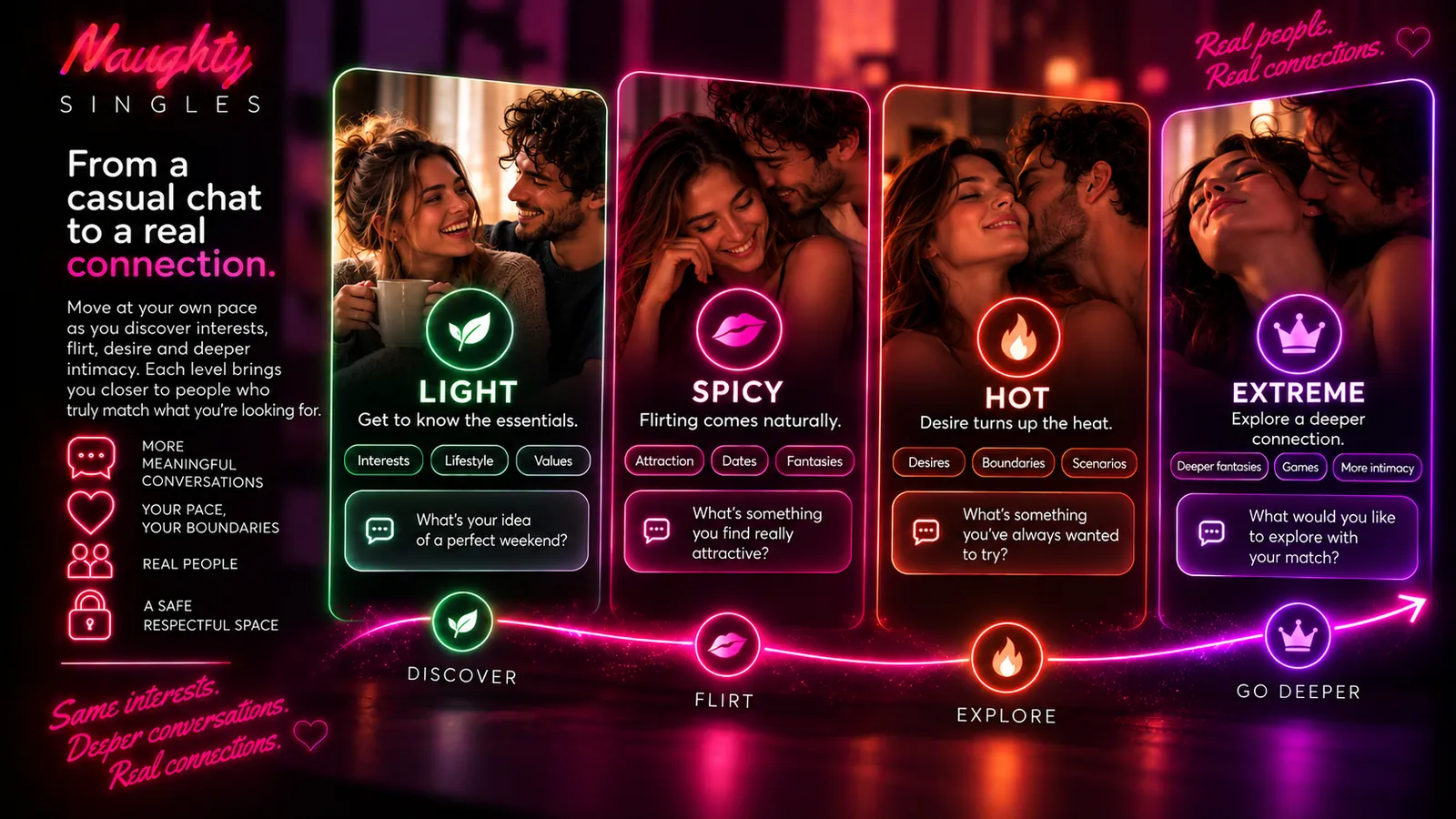
Most apps start with the one thing that tells you least: a face. Naughty Singles was built on the opposite idea, chemistry first, skin later, and it measures the spark and the fit separately.
You play cards with first-person statements and answer ME TOO, DON'T CARE or NOT ME. Your answers build your Match DNA across 40 categories organized in four opt-in intensity levels. LIGHT measures fit in daily life: habits, pets, drinking and smoking, health, family and kids, beliefs, money, social life, travel and romance. SPICY measures chemistry: attraction, how you flirt, who makes the first move, dating style, flirty texting, public affection, desire, the senses and temptation. HOT and EXTREME go further into desire and intensity, always as your choice.
Then the comparison does what a good friend would do. You're only compared on levels you both chose. More intimate levels weigh more. And the worst level weighs: if you're identical in daily life but opposite in chemistry, the total drops instead of averaging out. Your deal breakers work as a gate: someone far from you on one stays out of your top. Your top shows a percentage, a reading per level and why you'd connect, with faces blurred until there's real interest. After the match, the In Sync chat lets you test the spark live, answering questions blind and revealing together before free chat unlocks.
The app launches in English, Spanish and Portuguese at the same time, first on Android (iPhone comes later), and you can pre-register for early access.
Frequently asked questions
What is the difference between chemistry and compatibility?
Chemistry is the spark: attraction, energy and ease you feel together, often within minutes. Compatibility is the fit: whether your values, lifestyle, communication, intimacy needs and plans for the future let you build a shared life without constant friction. Chemistry tells you there's something between you; compatibility tells you whether it can last. The strongest relationships have both.
Is chemistry or compatibility more important?
For a lasting relationship, compatibility usually matters more over time, because it shapes every ordinary day, every decision and every conflict. But chemistry isn't optional: without any spark, a relationship can feel like friendship. Think of compatibility as the foundation and chemistry as what makes you want to live there. Aim for real chemistry on top of a solid fit.
Can a relationship work without chemistry?
Some relationships built on deep compatibility and friendship work well, especially for people who value calm and companionship over intensity. Chemistry can also grow slowly as trust builds. But if one or both people want attraction and it never appears after real time together, the relationship often feels like something is missing. It's worth being honest about what you need.
Can you have chemistry without compatibility?
Yes, and it's very common. Two people can feel an intense spark and still want completely different lives: different ideas about kids, money, commitment or how to spend free time. These relationships are often exciting at first and exhausting later. Enjoy the chemistry, but check the fundamentals early, before strong feelings make an obvious mismatch hard to see.
Does chemistry fade over time?
The early, novelty-driven intensity naturally softens as you get to know each other, and that's normal. But chemistry doesn't have to disappear. Couples who stay curious, keep trying new things together, laugh often and keep talking openly about desire tend to keep a real spark. Compatibility helps, because it removes the friction that often drains attraction.
How do dating apps measure compatibility?
It varies a lot. Many apps rely mostly on photos and a short bio, which says little about fit. Others use questionnaires. Naughty Singles uses first-person statements you answer with ME TOO, DON'T CARE or NOT ME, builds an affinity across 40 categories in four opt-in levels, and compares people category by category with a transparent algorithm, where the worst level weighs.